

It’s a complex and often controversial topic within Christianity, where differing interpretations of scripture shape various views on homosexuality. While many uphold the traditional belief that the Bible prohibits homosexual behavior, others advocate for a contextual and culturally sensitive understanding of the same passages. He, she, or they may encounter passionate debates focusing on whether biblical commands are timeless or historically bound. Throughout, there remains a strong call for grace, respect, and compassion toward all individuals, regardless of their sexual orientation.
Key Takeaways:
- The traditional Christian interpretation generally views homosexual behavior as sinful, based on specific Old and New Testament passages.
- Marriage is consistently portrayed in the Bible as a union between one man and one woman, reflecting God’s intended design for human sexuality.
- All direct biblical references to homosexual acts are uniformly negative, with no explicit endorsement of same-sex relationships found in scripture.
- Some revisionist perspectives suggest biblical prohibitions reflect ancient cultural contexts and may not apply to modern, consensual same-sex relationships.
- Debate exists over whether certain biblical commands are timeless moral laws or culturally-bound regulations subject to reinterpretation.
- Minority scholarly views question the traditional readings of key passages but are not widely accepted within mainstream biblical scholarship.
- Despite differing views, there is a shared emphasis on responding to the topic with grace, love, and respect for all individuals.
The Foundation of Traditional Beliefs: Scripture’s Stance on Homosexuality
Key Biblical Texts and Their Interpretations
The Old Testament contains several passages often cited in discussions on homosexuality, with Leviticus 18:22 and 20:13 standing out for their explicit prohibition of male same-sex acts, labeling them as an “abomination.” These texts are part of the Holiness Code, a set of laws aimed at setting Israel apart from surrounding nations, which frames homosexual behavior as a breach of covenantal purity. In the New Testament, passages such as Romans 1:26–27 reaffirm this stance by describing same-sex relations as contrary to natural order and divine intent. The Apostle Paul’s letters, including 1 Corinthians 6:9–10 and 1 Timothy 1:10, list “men who practice homosexuality” within groups excluded from inheriting the kingdom of God, reflecting a consistent theological position across both Testaments.
Many traditional interpreters highlight that these passages do not merely address behavior but are embedded within a broader biblical sexual ethic, emphasizing marriage as a union exclusively between one man and one woman (see Genesis 2:24; Mark 10:6–8). This model underpins the understanding of sexual relations within the covenant of marriage as God’s ordained framework. Despite variations in translation and some contextual nuances, the overarching narrative offers no explicit endorsement of same-sex relationships, instead presenting homosexual acts as incompatible with God’s design for human sexuality.
The Role of Context in Scriptural Understanding
Scriptural prohibitions on homosexuality are often read in light of their ancient Near Eastern contexts, where same-sex acts appeared frequently intertwined with idolatry, temple prostitution, or exploitative power dynamics rather than consensual, committed relationships. This raises questions about whether biblical condemnations universally apply to all forms of same-sex intimacy or specifically to practices violating social and religious norms of the time. Some contextual approaches argue that the Bible’s focus was more on condemning behaviors linked to pagan rituals than addressing loving, monogamous same-sex partnerships.
The continuity of sexual ethics across Scripture suggests a rootedness in the created order, yet cultural factors undeniably influenced how certain behaviors were perceived and legislated. Scholars engaging this aspect point to the difference between prescriptive laws tied to covenantal identity and broader moral imperatives. Incorporating the historical and cultural background enriches understanding but does not necessarily overturn the traditional interpretation. Instead, it invites careful discernment regarding which biblical commands are culturally conditioned and which are integral to Christian ethics.
Further exploration into the role of context reveals how the ancient authors’ intentions and the socio-religious milieu shaped the articulation of sexual norms. For instance, the prohibitions in Leviticus also regulate dietary practices and ceremonial cleanliness, many of which Christians consider fulfilled or transcended in the New Covenant. This selective observance underlines ongoing debates about applying Old Testament laws today. Meanwhile, the New Testament writings serve to both reaffirm and deepen moral teachings, though understanding their rhetorical style and audience-specific concerns remains important. Such contextual analysis encourages a nuanced approach, balancing respect for Scripture’s authority with awareness of its historical settings.

Marriage Through the Ages: A Biblical Paradigm
The Genesis Model: Marriage as Divine Design
The foundational biblical depiction of marriage is found in Genesis 2:24, where man and woman are united to become “one flesh.” This union is presented as a deliberate act of God’s creation, establishing a marital bond that reflects both relational intimacy and complementary roles. Jesus’ reaffirmation of this model in the New Testament, particularly in Mark 10:6–8, underscores the continuity of marriage as a divine institution intended for lifelong, exclusive partnership between a man and a woman.
This model not only defines the marital relationship but also anchors human sexuality within a created order. The union is meant to signify unity and procreation, as reflected in the Genesis narrative and echoed throughout Scripture. By situating marriage within God’s design, the biblical paradigm resists social redefinition, emphasizing instead an ordained structure that shapes Christian ethics on sexuality and family life.
Continuity and Change in Cultural Practices
While the Genesis model establishes the theological ideal of marriage, cultural expressions of this institution have varied significantly throughout history. Ancient Israelite marriage customs, New Testament practices, and later Christian traditions reflect adaptations shaped by social context, legal systems, and prevailing moral codes. For example, practices such as polygamy or arranged marriages appear in early biblical times but do not receive affirmation as the normative standard in later Christian teaching, which consistently moves toward monogamous union.
Church history reveals further modifications influenced by cultural and theological developments. Early Christian writers like Augustine emphasized marriage’s sacramental and covenantal dimensions, refining biblical understandings in dialogue with Greco-Roman cultural norms. By the Middle Ages, marriage became a legally and ecclesiastically regulated institution, codified in canon law and linked to social order and inheritance.
The ongoing conversation within Christianity about marriage exemplifies this balance between continuity and adaptation. While the core biblical vision remains—as a covenantal union between a man and a woman—the outward practices, rituals, and social functions have evolved in response to changing cultural realities. This dynamic interplay challenges Christians to discern which elements of marriage are divinely instituted and which are culturally conditioned, a distinction that directly informs contemporary debates on sexual ethics and the application of Scripture.
Grace in Confrontation: Theological Implications of Homosexuality
Sin, Redemption, and Christian Response
The traditional Christian understanding categorizes homosexual behavior as sin, based on clear biblical injunctions found in both Old and New Testaments. Passages such as Romans 1:26–27 and 1 Corinthians 6:9–10 explicitly list homosexual acts among behaviors inconsistent with God’s holiness. This theological framing places homosexual behavior within the broader narrative of human fallenness and the need for redemption. However, the concept of sin in Christian doctrine is consistently coupled with the availability of grace through Christ, emphasizing the possibility of forgiveness and transformation rather than condemnation without hope.
Christian communities that uphold the traditional interpretation often emphasize pastoral care centered on offering compassion alongside correction. They encourage individuals who experience same-sex attraction to seek spiritual growth and holiness while affirming their inherent dignity as bearers of God’s image. This dual emphasis reflects a commitment to uphold scriptural teachings as well as the call to love one’s neighbor, aligning with the overarching biblical message of redemption that includes all people regardless of their struggles or identities.
The Tension Between Doctrine and Compassion
The intersection of rigid doctrinal positions and the imperative of compassion generates a persistent tension within Christian responses to homosexuality. Many churches articulate unequivocal stances against homosexual acts while simultaneously stressing the church’s mission as a safe haven for all individuals. This balance seeks to navigate between adhering to what they interpret as divine moral law and extending grace and unconditional love to those affected. The challenge intensifies in pastoral situations where individuals face alienation, mental health struggles, or discrimination both within and outside faith communities.
This tension often manifests in a spectrum of approaches, from exclusionary practices to more inclusive pastoral care models that maintain doctrinal boundaries yet prioritize relationship and support. Some doctrinally conservative congregations have adopted counseling ministries that aim to help individuals reconcile their faith with their experiences, underscoring the transformative hope in Christ without compromising traditional biblical ethics. The complexity of these approaches illustrates the evolving landscape Christian communities navigate while engaging with contemporary social realities.
Numerous denominational responses exemplify this tension, such as those seen in the Southern Baptist Convention’s official statements emphasizing sexual purity alongside calls for loving outreach, or the Anglican Communion’s varied provincial approaches that range from strict adherence to traditional teachings to more affirming stances. Such diversity reflects the ongoing negotiation within Christianity as it wrestles with maintaining doctrinal integrity while embodying the radical hospitality modeled by Jesus. This tension persists as both a challenge and a catalyst for deeper theological reflection and communal discernment.

The Revisionist Perspective: Reinterpreting Ancient Texts
Contextualization of Scriptural Prohibitions
Revisionist scholars and theologians emphasize that many biblical injunctions concerning homosexual behavior were embedded within specific historical, cultural, and religious contexts. For example, the prohibitions in Leviticus (18:22, 20:13) are part of a broader holiness code aimed at distinguishing Israelite society from neighboring peoples, and these rules include a range of practices now understood as culturally bound, such as dietary laws and ritual purity regulations. They argue that applying these laws wholesale to contemporary ethical questions overlooks the original intent and setting of the texts.
New Testament passages, particularly Romans 1:26–27, are reexamined with similar caution. Some researchers highlight the language of exploitation, excess, and idolatry that surrounds these verses, suggesting Paul was condemning practices linked to pagan temple rites or abusive relationships rather than committed, consensual same-sex partnerships. This dynamic re-reading invites consideration that biblical prohibitions may not directly address modern understandings of sexual orientation or faithful same-sex unions, challenging the assumption that these texts offer timeless moral adjudications.
Exploring the Cultural Norms of Biblical Times
In the ancient Near Eastern and Greco-Roman worlds, same-sex acts often carried social meanings very different from those in contemporary society. Typically, such behaviors were interwoven with power imbalances, dominance, and ritualistic practices designed to reinforce status hierarchies or religious devotion. For instance, some scholars note that sexual acts condemned in the Bible were frequently linked to prostitution, temple cult practices, or exploitative scenarios involving slaves or youths, contexts far removed from consensual adult relationships grounded in mutual commitment.
Understanding the pervasive presence of patriarchy, honor-shame culture, and strict gender roles in biblical-era societies sheds light on why certain sexual behaviors were stigmatized. These factors shaped social cohesion and religious identity, meaning that sexual conduct outside these norms threatened more than personal morality—it challenged communal order. Revisionists argue this lens helps explain why the biblical texts might strongly denounce specific homosexual acts while leaving out any mention of enduring same-sex relationships conceived as egalitarian partnerships.
Ancient perceptions of sexuality were tightly connected to social structures, with homosexual acts often symbolizing subjugation or temple-related idolatry rather than expressions of romantic love. For example, in Greco-Roman contexts, same-sex relations commonly involved hierarchical relationships, such as between an active adult male and a younger or lower-status male, rarely portraying mutual affection or equality. The persistence of such social dynamics suggests that biblical condemnations targeted specific exploitative or cultic behaviors rather than a broader condemnation of all same-sex intimacy as understood today.
Bridging the Divide: Points of Agreement Among Scholars
Common Ground on Biblical Authority
Despite divergent interpretations, nearly all scholars engaged in the debate uphold the Bible as the authoritative foundation for Christian ethics and belief. Both traditionalists and revisionists accept that Scripture carries profound weight in shaping moral understanding, even as they disagree on hermeneutical methods. This shared conviction anchors the conversation, ensuring that discussions do not devolve into relativism but remain tethered to a common textual source.
Scholars also commonly acknowledge that interpreting biblical texts requires rigorous engagement with original languages, historical contexts, and theological coherence. Regardless of conclusions about homosexuality, there is consensus that passages addressing sexual behavior demand close exegetical attention, rather than casual or simplistic reading. Such agreement on biblical authority not only maintains respect for sacred texts but also fosters continued scholarly dialogue across differing perspectives.
The Nature of Timeless Moral Commands vs. Cultural Norms
The heart of the debate centers on whether prohibitions against homosexual behavior reflect timeless moral imperatives or context-specific cultural regulations. Most scholars agree that some biblical laws, such as dietary restrictions or ceremonial rituals, were clearly tied to the cultural and religious milieu of ancient Israel and have been rightly set aside in contemporary practice. The contention arises when determining if sexual ethics, particularly concerning same-sex relationships, fall into the same category or stand as enduring divine mandates.
This issue presses scholars to wrestle with how to apply biblical morality amid changing social and historical realities. Those affirming timeless commands argue that consistent scriptural condemnations of homosexual acts indicate an unchanging divine standard. Conversely, revisionist scholars emphasize interpretive frameworks that highlight cultural context and question whether biblical texts address the types of loving, consensual relationships present today. Both sides pose significant hermeneutical challenges, expanding the conversation beyond simple biblical literalism.
Exploring distinctions between eternal moral truths and culturally conditioned rules invites a nuanced appreciation of biblical ethics. The debate encourages Christians to critically assess how divine revelation interacts with human history, promoting humility and openness in engaging with Scripture’s complex witness regarding sexuality.
The Future of Christian Engagement: Navigating Controversy with Love
Compassionate Dialogue and Mutual Respect
Conversations around homosexuality within Christian circles often reveal deep-seated convictions and emotions, yet the path forward increasingly demands compassionate dialogue grounded in genuine respect. Various Christian communities are adopting forums and small group discussions that prioritize listening over arguing, enabling individuals of differing views to share personal stories alongside theological reflection. Initiatives such as the “Living the Questions” series and the work of organizations like the Ekklesia Project demonstrate how respectful engagement can foster understanding, even when fundamental disagreements persist. Encouraging such dialogue helps dismantle stereotypes, promotes empathy, and shifts the discourse from polarized rhetoric to relational connection.
Mutual respect acknowledges the inherent dignity of all persons, regardless of sexual orientation, while allowing theological convictions to coexist with empathy. For example, some churches have begun training leaders to approach pastoral care without immediate judgment, recognizing the tension between upholding doctrinal beliefs and ministering to individuals with love. This approach fosters environments where LGBTQ+ members and allies feel heard and valued without pressure to conform, advancing a relational ethic aligned with Christ’s example of grace. Such intentional, respectful engagement models how complex issues can be navigated without sacrificing spiritual integrity or human kindness.
The Role of the Church in Contemporary Issues
The Church’s response to questions surrounding homosexuality increasingly intersects with broader cultural, legal, and social developments, positioning it as a significant voice in ongoing debates about marriage, civil rights, and religious freedom. Denominations like the United Methodist Church and the Episcopal Church have experienced substantial internal conflict and even schism precisely because of differing stances on LGBTQ+ inclusion; these divisions highlight how pivotal this issue has become in shaping ecclesial identity and mission. In parishes and congregations across the globe, pastoral leaders are challenged to articulate Christian teaching while offering ministries that address loneliness, mental health, and discrimination affecting LGBTQ+ individuals, illustrating the Church’s multifaceted role beyond doctrinal declarations.
Engagement with contemporary issues requires the Church to balance fidelity to its understanding of biblical teaching with responsiveness to the lived realities of its members and society at large. Public statements by bodies such as the Vatican and the World Council of Churches emphasize upholding human dignity and opposing all forms of unjust discrimination, signaling a global Christian imperative to integrate justice and mercy. Programs focused on reconciliation and education often seek to equip believers to interact thoughtfully with this topic in secular spheres, while fostering internal community resilience. This dynamic rightly reflects how the Church remains a living institution, tasked with navigating cultural change without abandoning its theological foundations.
Case Studies: Perspectives from Different Christian Denominations
- Roman Catholic Church: Maintains a traditional stance that homosexual acts are intrinsically disordered and sinful, based on longstanding theological teachings and papal documents such as the Catechism of the Catholic Church (1992). While emphasizing pastoral care, the Church explicitly rejects blessing same-sex unions or permitting same-sex marriage rites.
- Southern Baptist Convention (SBC): As the largest Protestant body in the United States, SBC actively upholds the biblical prohibition of homosexual behavior. Its 2000 resolution asserts marriage is solely between one man and one woman, and it disfavors ordaining practicing homosexuals as clergy.
- United Methodist Church (UMC): This denomination exhibits sharp internal conflict. The 2019 General Conference reaffirmed a traditional View, prohibiting same-sex marriage and LGBTQ clergy. However, significant factions advocate for full inclusion, leading to global tensions and a proposed denominational split.
- Evangelical Lutheran Church in America (ELCA): Since 2009, ELCA permits ordination of LGBTQ clergy in committed relationships and allows ministers to officiate same-sex marriages. The denomination represents a shift toward revising traditional interpretations in light of contemporary insights.
- Episcopal Church (USA): Embraced same-sex marriage rites in 2015 and ordained openly LGBTQ bishops prior to that. It exemplifies a progressive approach, focusing on inclusion and reinterpretation of scripture within evolving cultural contexts.
- Eastern Orthodox Churches: Uniformly maintain that homosexual behavior is sinful, emphasizing asceticism and repentance. Same-sex unions are not recognized or blessed, reflecting deeply rooted traditional understandings.
- Presbyterian Church (USA): Since 2011, PC(USA) has permitted ordination of LGBTQ individuals and allows same-sex marriage ceremonies, representing a significant institutional move toward affirming LGBTQ Christians.
- Church of Sweden: A Lutheran national church, it officially blesses same-sex marriages and ordains LGBTQ clergy, demonstrating how cultural shifts in Scandinavian countries have influenced ecclesiastical policies.
- Assemblies of God: As a Pentecostal denomination, it strongly adheres to the traditional prohibition of homosexual practice, framing this as incompatible with biblical holiness and the Spirit-filled life.
- Metropolitan Community Church (MCC): Founded to serve LGBTQ Christians explicitly, MCC embraces full inclusion and advocates that scripture supports loving same-sex relationships, representing a revisionist theological approach outside mainstream Christianity.
Mainstream Denominations vs. Progressive Movements
Mainstream Christian denominations largely continue to affirm the traditional biblical interpretation prohibiting homosexual behavior and uphold marriage as a union between a man and a woman. For example, the Roman Catholic Church and many Orthodox jurisdictions adhere strictly to these teachings, citing both scripture and centuries of doctrinal consistency. They often emphasize pastoral sensitivity without changing core moral doctrines. In contrast, progressive movements and some Protestant denominations have adopted more inclusive policies, permitting same-sex marriage and ordaining LGBTQ clergy. The Episcopal Church USA and the Evangelical Lutheran Church in America are prominent examples, where cultural engagement and contemporary hermeneutics have driven significant theological shifts.
This divergence reflects broader debates over scriptural authority and hermeneutics. Traditionalists prioritize historic exegesis and view biblical prohibitions as universally applicable. Progressive factions argue that certain prohibitions must be contextualized, emphasizing the values of love, justice, and inclusion. The tension affects governance, clergy appointments, and sacramental theology, often producing institutional conflicts such as seen in the United Methodist Church’s ongoing denominational fractures.
The Impact of Cultural Shifts on Church Doctrine
Changing social attitudes toward LGBTQ issues have exerted profound influence on various churches’ doctrinal positions. In regions with greater societal acceptance of same-sex relationships, such as Western Europe and parts of North America, denominations have increasingly revised their teachings to affirm LGBTQ inclusion. The Church of Sweden’s official blessing of same-sex unions and the Presbyterian Church (USA)’s ordination policies embody how cultural openness encourages doctrinal adaptation. Conversely, churches in societies maintaining conservative moral values, including much of Africa and Eastern Europe, have reinforced traditional stances, sometimes in reaction to perceived cultural pressure.
This dynamic illustrates how cultural shifts intersect with theological interpretation, leading to ecclesiastical pluralism regarding homosexuality. Churches navigate between upholding inherited doctrines and responding pastorally to congregants’ lived experiences. For some denominations, this has necessitated synods and councils explicitly addressing LGBTQ inclusion, often resulting in intensely publicized debates, schisms, and redefinitions of community identity.
Additionally, cultural changes have prompted examination of scriptural texts through modern linguistic and historical scholarship, influencing doctrinal reconsiderations. The interplay between evolving societal norms and church teachings continues to shape Christianity’s diverse landscape on human sexuality.
The Importance of Contextual Understanding in Modern Debates
The Influence of Social Movements on Biblical Interpretation
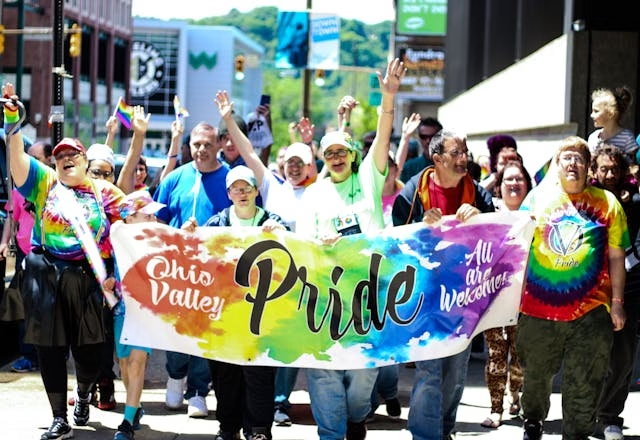
Social movements advocating for LGBTQ+ rights have played a significant role in shaping contemporary approaches to biblical interpretation concerning homosexuality. These movements have pressured many Christian communities to reexamine traditional stances by framing same-sex relationships within the context of equality, human dignity, and civil rights. In many cases, proponents of more inclusive theology argue that ancient biblical prohibitions fail to account for the lived experiences of loving, committed same-sex couples today, challenging longstanding interpretations as culturally conditioned rather than divinely mandated.
Conversely, the rise of progressive readings has prompted a defensive consolidation among traditionalists, who view shifts in biblical interpretation as influenced by external societal values rather than scriptural fidelity. This dynamic has heightened the polarization of Christian responses to homosexuality, with both sides appealing to scripture but often reading it through vastly different hermeneutical lenses shaped by the broader social climate. The intersection between activism and theology thus continues to influence not only public discourse but also internal denominational debates and pastoral approaches within churches.
Strategies for Engaging with Diverse Perspectives
Engaging thoughtfully with the diverse perspectives within Christianity on homosexuality requires a willingness to acknowledge both the complexity of biblical texts and the lived realities of individuals. One effective strategy involves distinguishing between descriptive and prescriptive elements in scripture, recognizing when cultural practices are specifically addressed versus when moral principles are intended as timeless. For example, some churches have adopted frameworks that hold fast to the marriage model presented in Genesis and the New Testament while exploring pastoral care approaches that emphasize respect and inclusion for all parishioners, regardless of orientation.
Dialogue initiatives that include voices from traditional, revisionist, and LGBTQ-affirming perspectives foster greater understanding and reduce polarization. Facilitated conversations in ecumenical settings or academic symposiums help participants unpack assumptions, clarify definitions, and explore how contextual factors—such as language, historical background, and cultural shifts—affect interpretation. These forums encourage Christians to engage with empathy and intellectual rigor, moving beyond caricatures to address the nuanced realities within the body of Christ.
Further refining these strategies involves developing educational resources rooted in sound biblical scholarship that remain accessible to lay audiences, coupled with training clergy to navigate sensitive pastoral situations with both doctrinal clarity and compassionate presence. Such efforts equip the church to maintain theological integrity while upholding a posture of grace—a balance that sustains communal unity amid ongoing debates.
Summing up
Drawing together the various viewpoints, the biblical perspective on homosexuality remains a deeply contested issue within Christianity, shaped largely by differing interpretations of scripture and theological emphasis. The traditional view, which dominates historic Christian teaching, holds that the Bible unequivocally prohibits homosexual behavior and affirms marriage as a covenant exclusively between a man and a woman. Proponents of this stance affirm that these positions are supported by a consistent reading of key biblical texts and emphasize the importance of grace and compassion in responding to individuals regardless of sexual orientation.
Conversely, revisionist and contextual approaches argue for a nuanced understanding that takes into account the cultural and historical settings of biblical texts, suggesting that some prohibitions may not apply universally to loving, committed same-sex relationships today. While these perspectives remain a minority within biblical scholarship, they reflect ongoing efforts among Christians to reconcile scriptural authority with contemporary experience and ethical reflection. Across all positions, there is a shared call for respectful and thoughtful dialogue, highlighting the intersection of faith, interpretation, and pastoral care in this complex debate.
FAQ
Q: What does the Bible say about homosexual behavior?
A: The Bible contains several passages that address homosexual behavior, including Leviticus 18:22, Leviticus 20:13, Romans 1:26–27, 1 Corinthians 6:9–10, and 1 Timothy 1:10. Traditionally, these texts have been interpreted as prohibiting homosexual acts, portraying them as inconsistent with God’s design for human sexuality.
Q: Is marriage in the Bible strictly defined as between a man and a woman?
A: Yes, the biblical model of marriage is described as a union between one man and one woman. This is evident in passages such as Genesis 2:24 and Mark 10:6–8, where marriage is established as part of God’s original design and intended for the complementarity of male and female partners.
Q: Are there alternative interpretations of biblical passages about homosexuality?
A: Some Christians and scholars propose that biblical prohibitions on same-sex acts were contextually tied to ancient cultural practices, such as idolatry or exploitation, and may not directly apply to loving, consensual same-sex relationships today. However, these revisionist views remain minority positions and are not widely accepted in traditional biblical scholarship.
Q: Why do some Christians question the applicability of certain Old Testament laws?
A: Certain Old Testament laws, such as dietary restrictions or ceremonial rules, are no longer observed by many Christians because they are considered part of the old covenant. This raises questions about which commands regarding sexual ethics remain binding, leading some to reassess how biblical prohibitions on homosexuality should be interpreted in the modern context.
Q: What areas of agreement exist among Christians regarding homosexuality?
A: Most scholars and Christian traditions agree that the Bible does not affirm homosexual behavior when interpreted in the traditional sense. The key point of discussion is whether biblical prohibitions are timeless moral laws or culturally specific rules that require reinterpretation in light of contemporary understanding.
Q: How are Christians encouraged to respond to individuals with a homosexual orientation?
A: Across various perspectives, Christians are called to respond with grace, love, and respect to all individuals, regardless of sexual orientation. Even those holding to traditional views emphasize the importance of compassion and recognizing the dignity of every person while upholding their theological convictions.
Q: What is the significance of cultural context in interpreting biblical texts on homosexuality?
A: Cultural context is significant because some scholars argue that biblical prohibitions addressed specific practices common in the ancient world, such as exploitative or idolatrous acts, rather than committed, consensual relationships. Understanding the historical and cultural background can influence how passages are applied today, though this approach remains debated within the Christian community.
Leave a Reply